Step 1: a script, scene by scene
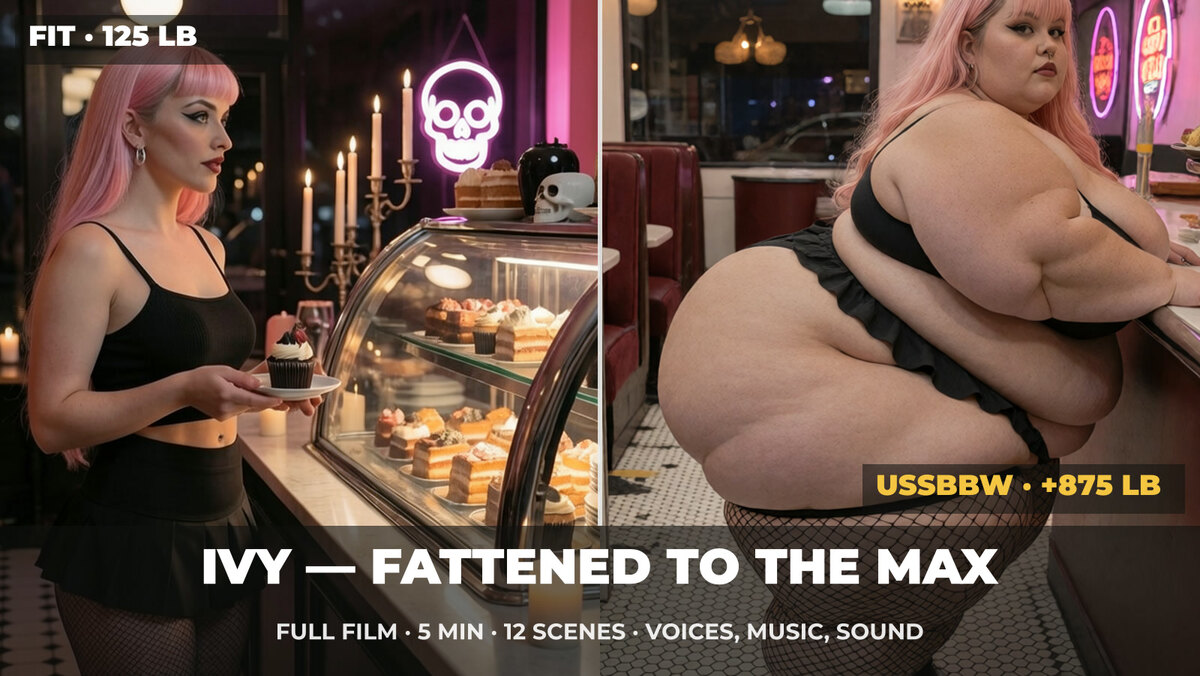
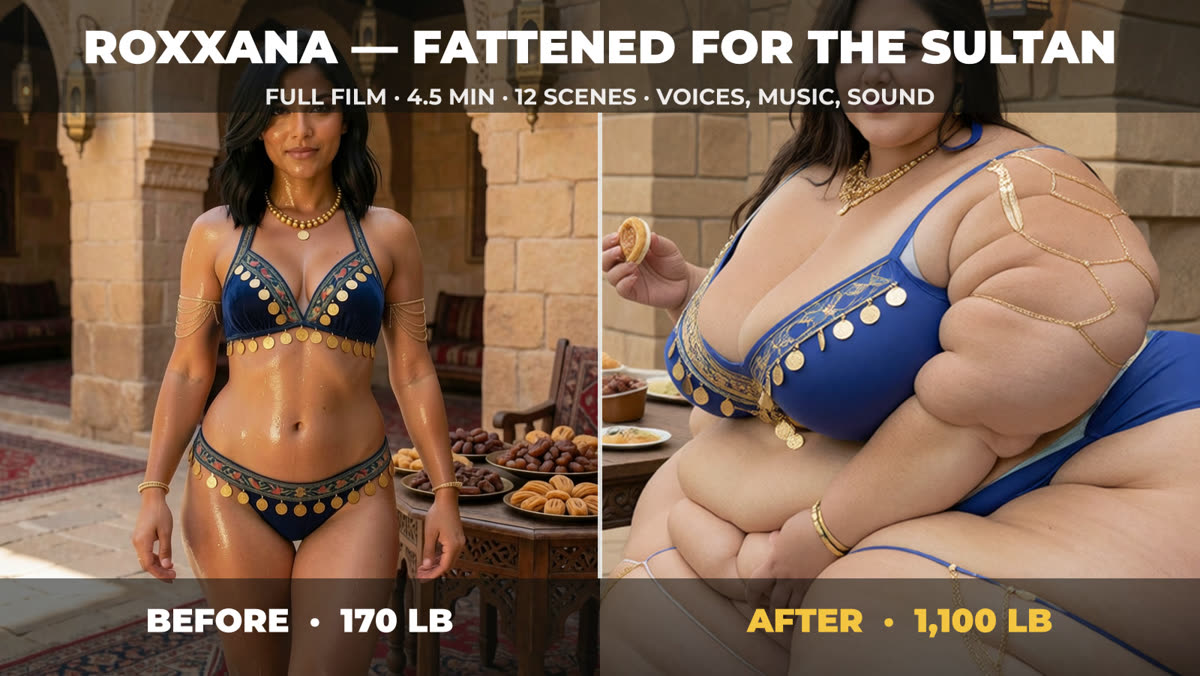
Every film starts as a screenplay. We write it scene by scene, with one idea per scene and one size per stage: a streamer whose chat sends food, a cook who promises to say yes to everything, a dancer in a palace feast contest. Writing first keeps the growth tied to something that happens. You can read the results as weight gain stories.
Step 2: still photos for each size
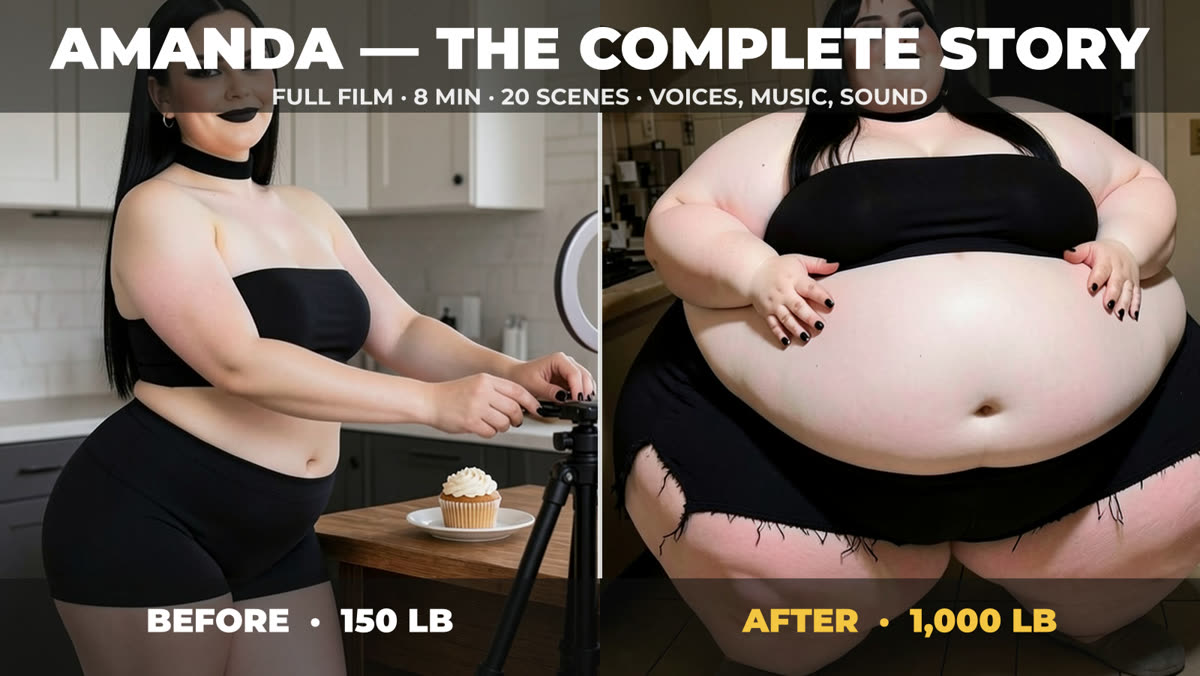
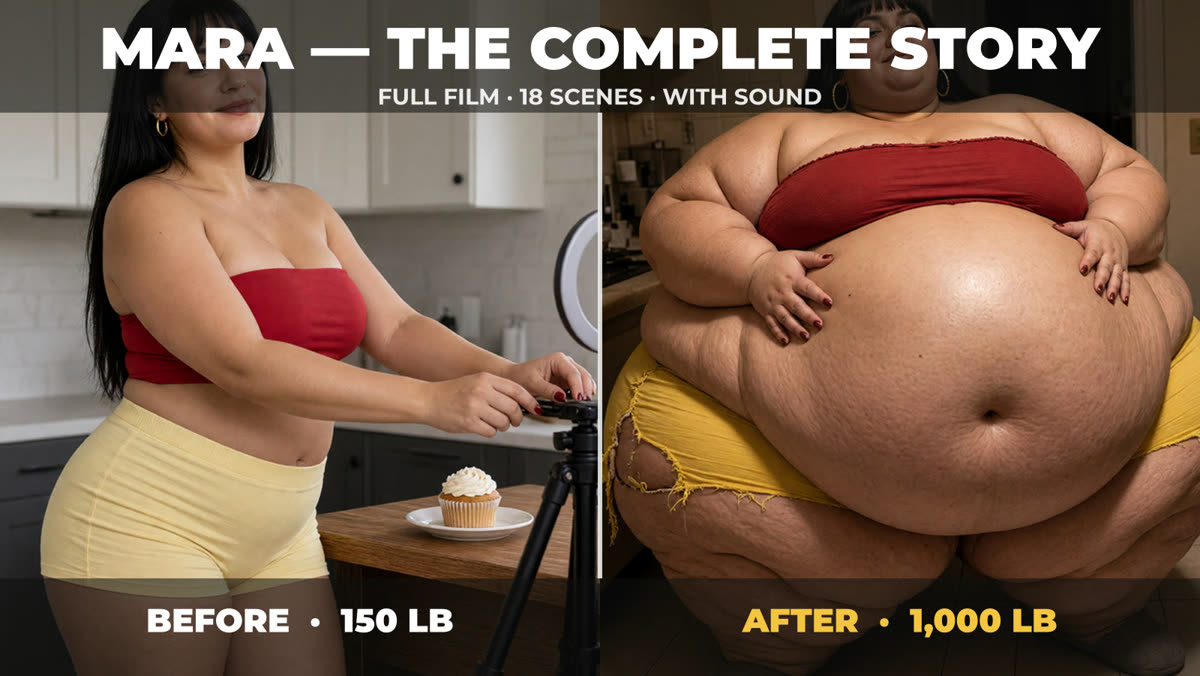
Next we create a still image for every stage, using AI image models. The hard part is consistency: the same face, hair, outfit and room at 150 lb as at 1,000 lb. We keep her outfit the same across stages so the change comes from her body, not from the wardrobe. These stills are what our photo comics are built from.
Step 3: growth clips from photo to photo
An AI video model then animates the move from one stage to the next, in clips of about five seconds. It starts from one photo and ends near the next, so she gets bigger in front of you. Slow clips look more natural than quick ones, so we keep the steps small. This is the core of what people mean by AI weight gain films.
Step 4: the shots we animate
- Front shots for the reveal of each stage.
- Profile views, because the line of her belly reads best from the side.
- The turn: she walks and turns all the way round, ending with her back to the camera.
- Eating, with bites and chewing, and being fed by a servant or friend.
- Full-belly shots, with hands resting on her stomach during the final feast.
Steps 5 and 6: sound and the cut
Clips are silent until we add the rest. We add a voice for lines, music for mood and sound for the details: plates, chairs that creak, a happy breath. Sound does a lot of the work of making a moving photo feel like a scene, which is why the final feasts are the most sound-heavy parts. See our page on belly stuffing scenes for why.
The last step is assembling clips, text and audio into a film of several minutes, with subtitles and a pace that lets each stage land. The finished films are in the galleries on DeviantArt.
Why photos first, clips second
It would be simpler to ask a video model for a whole growth scene in one go. In practice, a model asked to make a woman grow in a single clip tends to drift: the face changes, the room warps and the size jumps unevenly. Starting from approved stills fixes both ends of every clip. We know what she looks like at the start and at the end, and the model only has to cover the few seconds in between. It also lets us review each stage as a still before any video is made, which is cheaper than fixing it afterwards.
The same stills feed the free pages on this site. Look at the 480 lb stage of Amanda's film or the Mara comic to see what a stage photo looks like before it is animated.
What counts as a good clip
- The face is recognizably the same person as in the still.
- The outfit keeps its colors and details from the first frame to the last.
- The growth is smooth and slow, with no pops or sudden jumps.
- Hands, plates and furniture do not melt or change shape.
- The camera stays steady, or moves in one clear direction.
A clip that fails any of these is set aside and made again. Failed clips do not get into the film.
Honest limits
This is AI, and it has limits. Continuity is the hardest part: a face can drift, a hand can look wrong, and a necklace can vanish between clips. Some clips we simply discard and redo. Body motion on large sizes is difficult, and so is a long walk. We choose shots the technology handles well and keep clips short. If you want a different kind of weight gain animation, such as hand-drawn, this is not that.